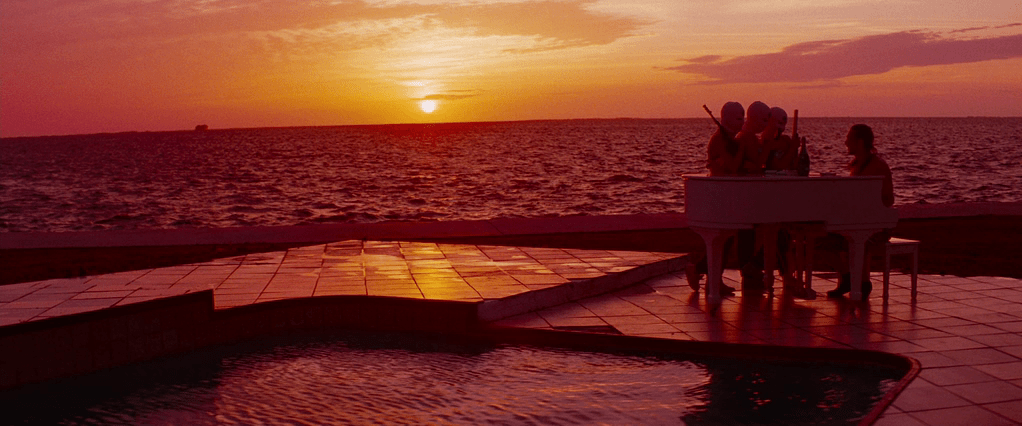

Watching Spring Breakers opening night in theatres was an experience I’ll never forget. It was a time when the cast were still considered a part of Disney shows, and it was their rise towards maturity. It was then advertised as the film to cover hedonism in a positive manner. They were people unaware of the transgressive and experimental nature of Harmony Korine’s work. During this screening, I lost count with how many walked out, and at the end, there was this uproar of gasps and shocked laughter. It felt as if I witnessed an act of subversion that will be remembered historically. This was the main reaction for this film during this time, and is still quite polarizing today.
Watching it recently, I realized that there are more aspects to this film that I initially thought. Its release showcased the nightmare of hedonism. How it’s used simply as a veneer for the nihilism for the youth. How they don’t have their place in life figured out yet, and need that mask of excess to lie to themselves how they are being content. The form was at its most subversive, aiming for an approach akin to Malick i.e. Voice-over narration, a focus on environments (Korine’s Industrial vs Malick’s Natural) and an ethereal atmosphere, yet one that’s appropriate for the heaviest of drug use.
However, as one revisits the film, seeing the film without the current trends, it is not only timeless as a whole, but also relevant on class and generational dynamics. The youth are the party animals, and even if slightly lower-class they are still more privileged, and through the guise of hedonism this shows their slow yet inevitable takeover of poor neighbourhoods. Basically, no matter what generation, the youth affects society the same way, and Spring Breakers is the perfect film to show this. It is one of the most essential works in nihilism. Nihilism in the form of the youth, alongside how they fuel the destruction of lower-class neighbourhoods.
$pring Break 4Ever
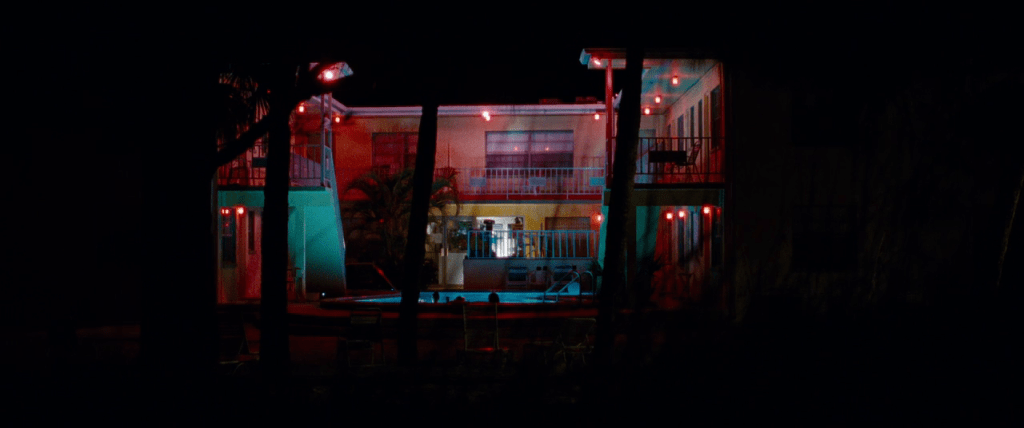
This film follows four privileged university students with perceived whiteness. They are one of the few remaining students on campus as the rest ventured to Florida for the Spring Break: the week of pure hedonism. It showcases this during the introduction of a beach party with objectifying shots of women doing everything aside from explicit sex, the men drinking every drop of alcohol they can find, with it all emphasized by the music of Skrillex, the popular brostep music at the time used during the hedonistic raves. These four university students want that experience; however, they don’t fully reach the high-class status that the other students have. This forces them to commit a robbery to afford the trip. During their heaven of hedonism, it all collapses when they get arrested for drug use and illegal partying, when a rapper named Alien bails them out as he saw something special with them. He then takes them towards another lifestyle of hedonism. One that is meant to be permanent. Complications arise for some of the young girls, but two remain as criminals who, with some assistance from Alien, do a complete takeover.
The Existential Deafness: Drowning in Brostep
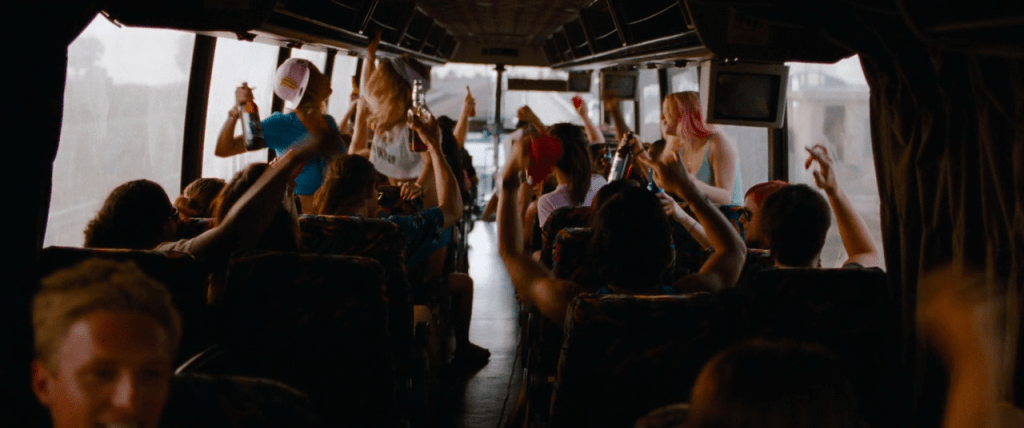
The message in its release is obvious. The girls get punished due to their hedonism but find it addicting to the point that it leads some to the life of crime. They are ones that want spring breaker to never end, with one girl Faith calling her mom to tell her that. It is during this repetition of hedonism that the film starts taking a darker turn. Thanks to its form of having a drugged out atmosphere with an editing style that jumps back and forth, slow motion, and various colour effects, it makes for an experience where you feel like you’re on drugs alongside them. However, as an outsider we can see past the veneer. We are not in denial like the girls are. We see the nihilism, and it’s scary. The jumpy editing is effective as well as it shows the climax of the scene before jumping back to the middle, going back and forth between each other. It becomes effective as you have this sense of dread of what’s going to happen, but a lack of knowledge of how it leads up to that, increasing tension.
Over a decade has gone by since its release. Skrillex, although still famous, is no longer as relevant in rave culture, and has evolved as an artist. Cell phones have now been introduced. The clothing styles also changed. On a surface level, this film is now out of date as the trends of the youth constantly fly by. However, there is that step towards adulthood that remains the same. Simply put, you realize that you’re not the protagonist in the world, you struggle to find your own identity, and the fact that you have a lot more responsibility in life. Many would be in denial of this. Some characters, such as Faith, would use her religion as guidance. Some may use acts of introspection to get through this existential crisis. Others simply delay it, if not ignore it altogether. This is where that mask of hedonism comes in. If their life consists of getting inebriated, taking part in drugs, alcohol, and sex. It can be fun, but it is a distraction. Why face the issues regarding your life when you are in no state to do so? Due to their age, in most cases this plausible for them. They live in cheaper housing on-campus, or with roommates. They may even have their expenses covered from their parents. There is a simple life structure of school for them as well, and although a lot of time is used, many students consider it a requirement in life more than their career advancements, thus resulting in acts such as skipping class or showing up hungover. The older citizens find a way to blame younger generations for their annoyances, specifically attacking that one generation. They completely miss the point. It is never that specific generation, but rather the youth themselves. They are always the same.
The New Colonialism

As for the gentrification angle, it is quite overt through the perspective of the plot. They are lower-class than the other students, but due to their racial identity they are still more privileged than some communities. This is introduced during the robbery scene. It is a lower-class establishment, and the majority of the customers are racial minorities. They take advantage of the racial minorities to be able to afford the trip. When they go into Florida and get arrested, a famous white rapper named Alien bails them out. He socializes with the lower-class in the neighbourhood, and feels like he’s one of them; however, he is not a racial minority. He is one that fits economically, but not socially, making his moniker a suitable name. He then introduces the girls to his own community which consists of lower-class parties among black people. In an amusing touch, one of the privileged teenagers is frightened on her first sight of black people, and immediately leaves to return home. This act is seen as these four girls moving into a low class neighbourhood, and are now introduced. With gentrification, many factors must be placed before the rent prices increase. The first step is to “weed out” the minorities and replace them with the youth. People who don’t have a lot of money either, but are more privileged, and seen as the more stable members of the community through landlords and other members of the exploitative class. They come in for the cheap rent, and the businesses within their vicinity slowly begin to change into ones more suited for their lifestyle.
Of course, this takeover takes time, and through the remaining three girls it shows that drastic measures have to be taken. Firstly, they take over Alien, dominating him immediately and using his guns as phallic symbols to switch the power dynamics between them. He was part of the racial minorities beforehand, living with them his entire life. However, he is easily swayed into pleasing his the rest of his privileged identity. He does this by having the girls join as criminals to take over the lead gangster of the neighbourhood. There are complications on the way, but it leads to a shootout with the remaining two girls, Alien, and the black gangsters. As they win, the racial minorities are gone. The cultural and racial takeover is now complete. The younger, white girls have taken over the neighbourhood.

As with most subversive works such as this, it takes time for the resurgence and praise to arrive. Aside from it being in the top 10 of the year list from Cahiers du Cinema, it is now entering various canon lists for the best of the 21st century. I can confidently say that as the nostalgia for this film will disappear, the content analyzed here will become more overt, and there will be even more praise.
 Auteur Outlier
Leave a comment