

Radu Jude is arguably the most polarizing contemporary director. Although the content of his films remained consistent, showing a sense of social realism with a political view on the decay of post-communist Romania, but they slowly leaned more and more into an essayist stylistic choice, rather than being part of the Romanian New Wave that many are used to. COVID has brought a new era among humanity, and like COVID, Radu Jude abandoned his previous approach to cinema, using a much more aggressive, crass, and arguably “low brow,” Brechtian style, polarizing cinephiles and critics to the point that the overall consensus is torn on some of his work, such as the lower Rotten Tomatoes score with his most recent film Dracula. Focusing on his major feature length projects (excluding the shorter works Kontinental ’25, and Eight Postcards from Utopia), my aim is to show that Jude’s post-COVID shift in style is not a case of “COVID brain fog,” but rather a progression that utilizes a Brechtian style that elevates his essayist approach to topics, providing a more effective film while balancing it out with crass humour to not overwhelm a viewer with an overly serious and pretentious approach.
Loony Porn, Marxist Theory, and the New Romanian Cinema
The era starts with the film Bad Luck Banging or Loony Porn, and immediately goes for his current aggressive style. It starts out with an unsimulated sex tape with the protagonist Emi. It’s immediately provocative, meant to offend some, and is a critical move towards leaving behind any sort of Romanian New Wave sensibility. She’s a teacher at a prestigious school, and due to her partner leaking the tape she has to meet with the student’s parents who demand she be fired. Although this aims for a plot that may deal with social realism, it is one that the Romanian New Wave would never explore due to its crass nature, and one that may come across as an act of created outrage purely for the fun of showing content like this in prestigious film festivals. However, it is through Jude’s use of Marxist theory that makes this effective in its outlook of various topics.
Eisenstein said that he utilized this theory in his editing style. Two shots can create a contrast between each other, forming a new idea. The thesis, antithesis, forming a new synthesis which he explained in the most succinct and accessible way. It was started with the very well-known Kuleshov effect, without those knowing of its use of dialectics. Radu shows the various aspects of history, sex, the socio-political climate, and the ruins of Romania through both Ceaușescu and capitalism through post-communist shock therapy. It is the didactic version of the Kuleshov effect. One that would fall into Eisenstein’s intellectual montage as opposed to tonal. He simply uses the contrast in three different filming methods, the thesis, and antithesis, and you as the viewer create the synthesis.
The first act shows Emi walking through the streets of Romania, showing the decay caused by not only the covid era, but the modern day as a whole. It is done in an almost subversive way, as the Kuleshov effect isn’t used here, but rather the simply pan method. The thesis is set by showing an initial item that Emi is looking at, or walking nearby, then the camera pans towards a new item, creating that new meaning for the viewer. She window shops, and sees books for sales about Jesus, and then it pans to backpacks of the The Emoji Movie. Many new ideas are shown through this, and despite its slow pacing it makes for a very effective and amusing approach, especially with the vast array of billboards that have no consistency in terms of themes nor continuity.
The second act is purely an essay film. Many photographs are used, yet the Kuleshov effect is fully utilized. It is a compilation of dictionary definitions accompanied with sometimes completely random visuals, yet during the subsequent shot they provide that needed context to provide that synthesis. For example, a random pool party may cut to a shot of a disaster of a waterslide full of trash in rural Romania. This is my favourite portion of the film as despite this formal approach, he recognizes the format of it and helps elevate it by utilizing crass humour to keep things interesting, wanting the viewer to know what’s next to come, as they will have no idea if it’ll cover a serious topic about a genocide, or if a nude woman is being chased by a man wearing a suit and a bull mask. No matter what it is utilized in its vast array of seemingly random shots, Radu shows he is in full control here. You will develop your new idea of the two contrasts.
The final act goes for the more overt way, and makes it challenging in a sense of how something like this works. It consists of the meeting between Emi and the parents. It goes through their ways of presenting arguments, sometimes by literally reading entire essays out loud in an amusing way. This is still dialectics as the two different ideas are presented. A lot of it falls under visual gags alongside slight and amusing touches. For example, they all have to view her sex tape again. One of the parents decides to eat a banana while watching it close up, and an incredible shot it shown of someone holding the tablet showing the sex tape, while behind is a shot of a statue of a lion starring towards you, not unlike the lion you see in the Odessa steps scene in Battleship Potemkin. As the arguments go back and forth between the characters, not only do they develop their own synthesis, but you as the viewer have to step into it and choose your final opinion from that. It then goes for an amusing conclusion, albeit disappointing depending on the viewer; however, that is the point. It’s not about how it ends, and he knows this. It’s about what you want the ending of it to be. It creates that Brechtian cinematic approach as the viewer has created the ending, and the ending of the film itself simply is the step on the ladder, the response of what your final thought is.
The Vanishing Self: Labor, Loneliness, and Identity

With his next film Do Not Expect Too Much from the End of the World, it is a fascinating direction as it may be seen as provocative and inaccessible due its slow-paced and minimalist content. However, I would argue that they go about this film the wrong way. It is his most accurate and relatable film on the late-stage capitalist system, its exhaustive nature, and how it draws us towards desperate ways to seek, or remain, in our identity.
It follows Angela, brilliantly portrayed by Ilinca Manolache, who is a personal assistant for production companies. She wakes up at 5:50 am, and goes about her incredibly long working day. It is seen as a minimalist portrayal as most of it consists of her driving from client to client to record audition footage for a safety PSA for clients that own international factories, with one being based in Bucharest. She goes for the approach that many people, regardless of age, go through with working long hours. Her identity practically disappears because of the lack of downtime. Therefore, the identity, her “fun,” is dependent on her interactions with clients. As most of our jobs are unsatisfactory, it comes down to who you interact with that makes it tolerable. For example, if it’s in retail, even if the customers are grating, it’s up to the coworkers that you interact with. If both are intolerable, then your identity is gone as you have no healthy interactivity in your life anymore.
It portrays the use of social media in this society as well; however, it has a much smarter aspect to it rather than “society is so dumb from social media.” The use of scrolling through your personal algorithms is also seen as you forming your own identity, even if it is just an illusion that is fully controlled by the app itself. The other aspect are the younger people disillusioned with the system itself. Like Angela, and myself included, we all try to become social media sensations, believe that it is an “easy way out.” A way to make your own identity, and to finally strike that bullseye in the world of work-life balance. It is naive, as the deeper you go into it, realizing how harsh aspects are such as SEO, and the addictive nature of the app’s algorithms forcing you to work more, than it is just like any other job. However, everyone falls for it. Angela has the idea of using an Andrew Tate filter, making a sexist character that goes on absurdist and frankly hilarious rants, constantly talking about mouth-fucking women with pride. What she fails to learn, alongside many small content creators, is that no matter how brilliant the idea is, it all comes down to luck. The touch of Andrew Tate is fitting as well, as he is known for moving to Romania, and was charged for sex trafficking.
During her job as a personal assistance, it goes for the accurate and depressing approach of how we are taken advantage of with our capitalist system. Her clients are people injured in the blue-collar industry, and the company wants the clients to essentially whitewash their story to the point that they are seen to be the ones at fault for failing to follow regulations, no matter how absurd the claim is. The system exploits them, and then they never get their proper justice over it. In fact, Radu takes it deeper with that. While Angel is driving around, he shows another film called Angela Moves On, a slice of life film about a woman taxi driver. He uses the locations of the film to juxtaposition of this film to show the same locations, thus showing that the overall system remained the same, no matter who is in charge. It is also brilliantly meta, as the lead of Angela Moves On is also in this film, being the mother of one of the clients.
This film is the most relatable film in recent memory. Anyone that has to work long hours, thus losing their sense of identity, and try to reclaim any sort of semblance of that aspect through interactions in the workplace, or through social media once every so often will find themselves in this film. It is very long, and it mostly portrays one work-day, but that is the point. Her work-day is long, and as we experience how exhausting it is through her point-of-view, we realize that we too go through this as well.
Digital Stakes: Radu Jude’s Bold Stand Against AI’s Artistic Impalement

His most recent film Dracula, is his most inaccessible, and essayist approach to films. It is also his most juvenile, and all the more better specifically for that reason. The film critic Will Sloan compared this to Godard’s King Lear, whereas I find the comparison of late period Godard fitting, as well as the humour of a film such as Freddy Got Fingered. The use of Dracula is overarching in this film. It follows the exploitation of both him, and his inspiration Vlad the Impaler, in how capitalist Romania uses them for the tourist industry. The most surprising comparison is that this film is focused on AI. Dracula is known for sucking the blood out of humanity; so, what better way to showcase this then to show how AI is sucking the blood out of humanity by being humanity’s replacement for art.
It follows a hack director who admits he has no talent, breaking the fourth wall in order to tell the viewers of his film ideas and how he is aiming for the next highly successful film. He does this by creating AI prompts, leading to an anthology of fifteen short films, most having some connection to Dracula (some just aim for mainstream success in general), thus creating a more overarching form of his didactic method. During this, it shows a sort of sex-related tourist attraction where Dracula and another vampire woman do a performance. It ends with an auction to have sex with Dracula, and the finale being a chase scene for both of them while the tourists hold stakes. It is an overt yet very entertaining depiction of Dracula’s exploitation, as when they try to quit and use more effort in trying to hide, they discuss their workplace and how they try to find themselves in better places in life. Once again, it follows his consistency in regards to late-stage capitalism, yet this seems a lot more amateurish. The camera style is chaotic, hardly following the extras during the chase scene, and onlookers are very confused. It is a piece of guerrilla filmmaking that I have the utmost respect for. Radu is clearly breaking the rules in this film. It is a total disrespect for art, fitting for the ethics of AI, and this portion isn’t even following the AI prompts made by the director.
The fifteen short films are the highlights. It involves ‘classic love stories’ that are incredibly problematic, made lifeless by forcing in AI establishing shots that have no semblance of consistency among the environments of the film itself, and breaking the overall rhythm of the short. There is a 50 minute segment of a classic vampire story done at its most immature, and frankly entertaining manner, and has a complete disregard for continuity, as they would film in places where cars are going by, or tourists even walking beside the characters as they are acting. There are ones are made purely with AI done at its most disturbing, such as a sex scene that turns into body horror that would make Cronenberg walk away in disgust.
It reaches a total disrespect for art to the point that the director even apologizes for the 50 minute segment, saying that it was incredibly boring. He even breaks the cardinal sin of using Murnau’s version of Nosferatu for commercials, such as him promoting penis-enlargement pills.
Many of these stories are offensive, low-brow, exhausting, and can even be a pain to sit through. Fortunately, he knows to utilize humour to keep it exciting enough for viewers that enjoy his sense of humour, and its entire purpose is to create bad art on purpose to show the ineffectiveness of AI art. It is a work of subversion, and one that will be despised by most, but will be talked about in years to come. As of now, it is my favourite film of the year, and I can’t wait to see his depiction of Frankenstein, starring the mainstream Hollywood actor Sebastian Stan.
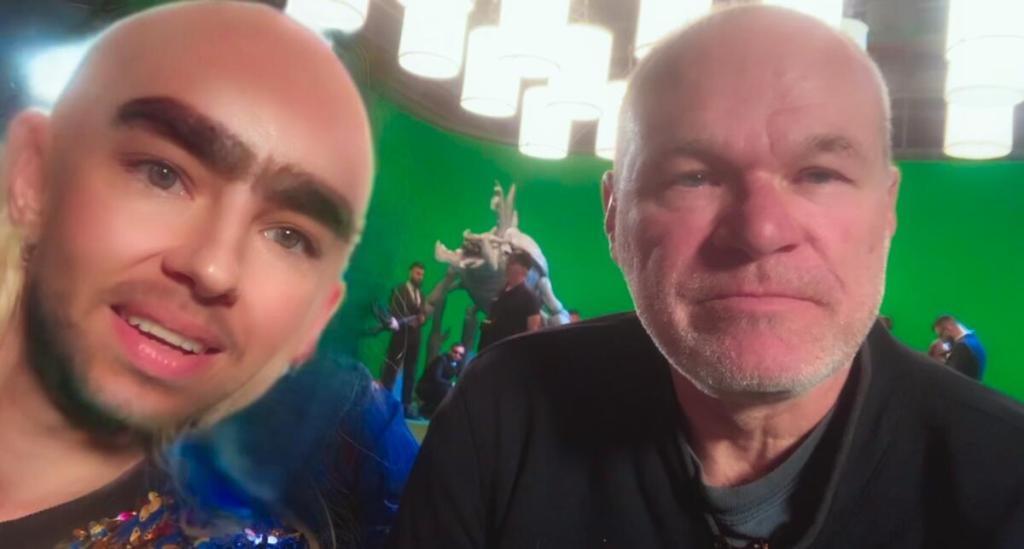
Radu Jude showcases how his recent, post-COVID use of being a provocateur is what will establish him as an artist that will remain relevant in both current-day, and retrospective discussions. Being as transgressive as he is, it is what pushes art to its limits, breaking new ground and assisting future directors. He is known that utilizes formal theory, yet done in a way to not make seem like you are going through an obtuse academic lecture. From the use of the synthesis, the modern-day Andrew Tate style social media presence, to the depiction of AI, they are all done to showcase the socio-political argument against capitalism and how it is affecting us, and art as a whole, in the modern day. His style, simply put, is the perfect combination of high-brow, and low-brow. Or, like the Andrew Tate filter Angela uses, unibrow. His work is entertaining modernism, one where we are engaged with how provocative it is, yet are having a blast doing so, regardless of how exhausting it is.
 Auteur Outlier
Leave a comment